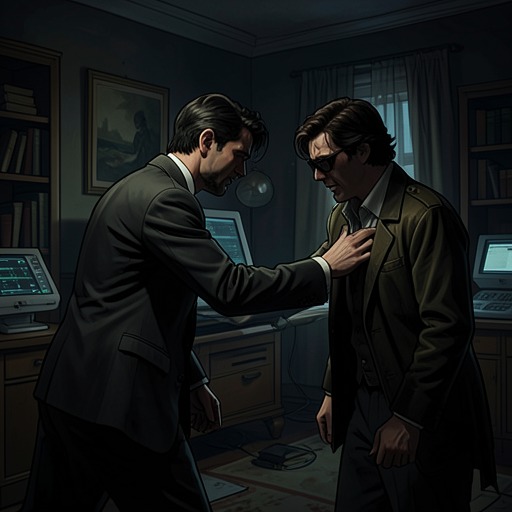
Frank Cotton and Rory’s brotherly relationship
The Hellbound HeartFrank Cotton and Rory’s brotherly relationship moves from childhood intimacy to adult distance, then returns in a grotesquely altered form when Frank depends on Rory’s blood and ultimately assumes his identity. Their shared history makes Frank’s return more than a supernatural intrusion: the brother Rory seldom speaks of becomes the presence hidden inside his home and, finally, behind his face.
Childhood and Estrangement
Frank and Rory were only eighteen months apart in age and, as children, were inseparable. Their closeness did not survive adolescence unchanged. Their paths diverged, and Rory came to regret the growing distance between them, as well as the distress Frank’s conduct caused their parents. Frank appeared only occasionally, returning from places where he had been living recklessly and bringing stories of petty crime and other disreputable experiences. Rory remembered him with a mixture of revulsion and envy: Frank’s disregard for ordinary restraint had appalled the family, but it also gave him a dangerous fascination.
During Rory’s marriage to Julia, he seldom mentioned his brother. Julia learned more in a drunken conversation a month or two before the wedding, when Rory spoke at length and mournfully about their shared past and subsequent separation. His account made Frank seem at once a source of family grief and a figure of unsettling freedom. Julia’s curiosity sharpened before she met Frank in person, and when he appeared less than a fortnight before the wedding, his polished, tanned appearance contrasted with the troubling stories she had heard. Their family connection thus became part of the attraction: Frank was not an unknown stranger, but Rory’s brother, already invested with a history Rory regretted and Julia wanted to understand.
Shared House, Separate Lives
The brothers inherited their grandmother’s house together. When Rory and Julia returned to it, the neglected property made Frank’s absence conspicuous. Rory described it as belonging to both brothers and remarked that nobody had seen Frank for some time. A neighbor remembered an odd tenant who had stayed in the house for a few weeks the previous summer; Rory’s identification of the tenant as his brother briefly embarrassed him. Julia quickly steered the conversation away from the disclosure.
The shared inheritance preserved a practical tie after emotional closeness had faded. Yet Rory’s remark that Frank had little interest in property reinforced the difference between them: Rory had settled into marriage and the work of making the house habitable, while Frank remained associated with departure and an unsettled life. Julia recalled seeing him about a week before the wedding, a final glimpse that preceded his disappearance from the ordinary world. The house that belonged to both brothers would later become the place where their separation could no longer be maintained.
Frank’s Return Through Rory
Frank was trapped beyond ordinary human reach, but Rory’s blood, spilled in the Damp room, gave him enough strength to make contact with Julia. Frank’s own recollection links his chance of escape to an earlier moment when Rory’s slipping chisel caused pain and left something of Frank behind. These traces—first the remnant Frank had preserved, then Rory’s blood—turn the brothers’ connection into the means by which Frank can begin to return.
Julia understands that the blood has nourished Frank and begins supplying more. Her actions are not an expression of loyalty to Rory: she kills men to provide Frank with what his incomplete reconstruction requires. Frank’s dependence on his brother is therefore indirect and morally inverted. Rory does not knowingly rescue him; instead, the consequences of Rory’s earlier injury and later bloodshed become resources through which Frank can reach the living. Their old familial bond persists as material dependence even when the brothers cannot meet as equals.
Kinship Replaced by Usurpation
When Frank is restored enough to move through the house, the brothers’ relationship ends in violence. Frank kills Rory and takes his skin, converting the familiar identity of a brother into a disguise. For a time, he can present himself as Rory, but the resemblance conceals a reversal rather than a reunion: the man speaking and appearing as Rory is Frank, while Rory’s corpse remains upstairs.
Kirsty recognizes the deception by bringing together details that do not fit Rory and the knowledge that Rory is dead. Her recognition exposes how completely Frank has turned kinship into camouflage. The face that should signify a known brother instead conceals the brother who destroyed him. When the Cenobites reclaim Frank, he tells Kirsty that she has caused his capture; she acknowledges her role. The brothers’ shared history does not reconcile them or save either one. It supplies the means of Frank’s return, and the familiar identity of Rory becomes the final instrument of his betrayal.
Significance of the Bond
The relationship’s movement from childhood inseparability to estrangement and substitution makes the story’s horror intimate. Frank is not merely an intruder in Rory’s house: he is a brother whose absence has been part of the household’s history and whose return exploits the traces Rory unknowingly leaves behind. Their inheritance keeps them linked in the ordinary world; blood and bodily likeness later turn that link into a means of survival and concealment.
The final impersonation also sharpens the contrast between family memory and outward appearance. Rory had remembered a brother who had become a source of grief, and Julia had encountered Frank as a magnetic figure whose visible manner concealed what he had become. Kirsty’s discovery confirms that appearance cannot restore the lost relationship: Frank can wear Rory’s identity, but he cannot become Rory. The brothers’ bond survives only in distorted forms—memory, accidental aid, and stolen likeness—until Frank is taken away and the identity he has usurped is exposed.